1998 Woodbury MN Homes Reaching Replacement Window
If your Woodbury home was built in 1998, you are approaching a threshold that every roofing contractor in Washington County recognizes immediately. Architectural shingles installed during the late 1990s building boom carry a standard lifespan of 20 to 30 years, and many of those roofs are now pushing or exceeding that range. The question is no longer whether replacement is coming — it is whether you are ahead of the problem or already behind it.
Why 1998 Woodbury Homes Are a Specific Concern Right Now
Woodbury experienced significant residential development through the 1990s as families moved into Washington County from the Twin Cities metro. Subdivisions in areas like Colby Lake, Stonemill Farm, and Bailey Elementary neighborhoods filled in rapidly, and most builders used 25-year architectural shingles as the standard product. Those shingles were installed between 1996 and 2002, meaning a large cluster of Woodbury homes is hitting end-of-life within roughly the same five-year window.
This creates two important dynamics for homeowners. First, roofing contractors in the area are increasingly busy with this wave of replacements, which affects scheduling and sometimes material availability. Second, if your neighbors are replacing roofs around the same time, HOA communities and city inspection activity tend to pick up, which can put pressure on your own timeline.
What 25-Year Architectural Shingles Actually Look Like at End-of-Life
The term 25-year shingle refers to a manufacturer's warranted lifespan under normal conditions. In Minnesota, that warranty is stressed by freeze-thaw cycles, heavy snow loads, and summer hail events that are common in Washington County. Most contractors working in Woodbury will tell you that a 1998 architectural shingle roof that has never been replaced has likely given up most of its remaining service life by now.
Visible signs that your shingles are past their prime include granule loss that exposes the darker asphalt mat underneath, shingles that are curling at the edges or cupping upward in the center, cracking along the shingle tabs, and dark streaking from algae or moss growth that has had years to embed into the surface. These are not cosmetic issues — they indicate that the shingle's protective layer is compromised and that moisture is beginning to reach the underlayment and deck.
The Deck Condition Question
When homeowners in Woodbury think about roof replacement, they typically focus on the shingles. What matters just as much — sometimes more — is the condition of the decking underneath. On a 1998 home that has been through 25-plus years of Minnesota winters, it is not uncommon to find soft spots, delamination, or rot in the plywood or OSB decking, particularly around valleys, penetrations, and the lower edges of the roof where ice dams form.
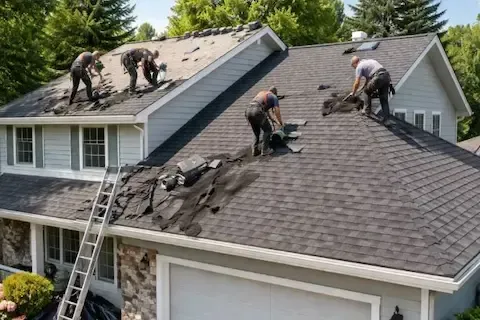
A full Roof Replacement in this situation means stripping everything down to the deck, assessing its condition board by board, replacing any damaged sections, installing new underlayment, and then laying the new shingle system. If a contractor offers to install new shingles directly over an existing layer without addressing the deck, that is a shortcut that creates problems within a few years — especially on a roof this age.
HOA Timing and Neighborhood Coordination
Many of the subdivisions that filled in Woodbury during the 1990s are governed by homeowners associations, and HOA guidelines often specify approved shingle colors, profiles, and sometimes materials. If you are in a community like Settlers Ridge or similar planned developments, check your association documents before scheduling a replacement. Some HOAs have pre-approved product lists, and some require a submission and approval process before work begins.
The upside of this requirement is that when multiple homeowners in a neighborhood are replacing roofs simultaneously, contractors sometimes offer reduced mobilization costs because they can stage equipment across several jobs on the same street or block. If your neighbors have already approached a contractor, asking about a shared scheduling arrangement is worth exploring.
Practical Considerations Before You Call a Contractor
Before you start getting estimates for your 1998 Woodbury home, there are a few things you can do to make the process more efficient. Pull your original homebuilder documents or any prior roofing permits if you have them — these can confirm what shingle product was originally installed and whether any warranty transfers were registered. Check your homeowner's insurance policy language around roof age, because many insurers in Minnesota apply depreciation schedules or actual cash value calculations to roofs that are more than 20 years old, which affects any future claim.
Also, take a careful look at your gutters. On older homes that have not had roofing work done recently, gutters often hold years of granule accumulation from shingle deterioration. Heavy granule deposits in your gutters are one of the clearest indicators that your shingles have been shedding their protective surface coating for some time. For a broader overview of what the full process involves, reviewing a roof replacement guide specific to this region can help you understand what to expect from inspection through completion.
Common Mistakes Woodbury Homeowners Make at This Stage
The most frequent mistake is waiting for an active leak before taking action. By the time water is appearing on your ceiling or in your attic, the damage has usually progressed through the shingles, the underlayment, and into the deck — sometimes affecting insulation and framing as well. At that point, what would have been a standard replacement job becomes a more involved repair and replacement project.
A second common mistake is choosing a contractor based on price alone. Washington County has seen its share of storm-chasing contractors who move through the area after significant weather events, offer aggressive pricing, and complete work that does not meet local installation standards or manufacturer specifications. Low installation quality on a 25-year shingle will reduce its actual service life to 10 or 12 years in a Minnesota climate.
Local Considerations Specific to Washington County
Washington County homes face a particular combination of weather stressors that does not apply uniformly across Minnesota. The eastern metro corridor where Woodbury sits sees significant freeze-thaw variability through late fall and early spring, which accelerates shingle cracking and promotes ice dam formation at eaves. Attic ventilation on 1998-era homes is worth evaluating at the same time as shingle replacement, because under-ventilated attics create heat buildup that cooks shingles from underneath and shortens their lifespan regardless of shingle quality.
Woodbury's permit process for roofing work is managed through the city's building department, and a licensed contractor will pull the required permit before work begins. If a contractor does not mention permitting, that is a red flag. Permitted work creates an inspection record that protects you at resale and confirms the job was completed to code.
A Practical Perspective on Timing
If your home was built in 1998 and the original roof has never been replaced, you are in the window where acting proactively makes more financial sense than waiting. A roof that fails under a winter storm or creates interior water damage costs significantly more to resolve than a planned replacement on your own schedule. Getting a professional inspection now gives you accurate information about where your roof actually stands — and in many cases, contractors can confirm whether you have one season of margin or whether replacement should happen before the next winter cycle begins.
